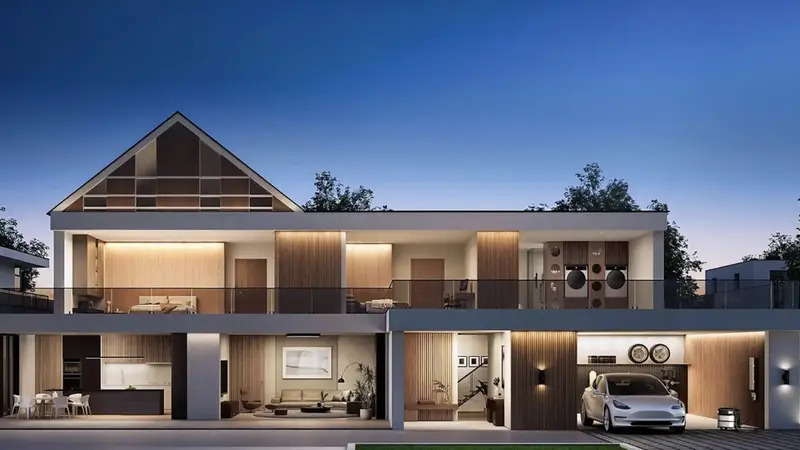
No, in most cases you do not need a whole home generator just for a garden or patio, because outdoor loads are usually small and intermittent, while whole-home systems are designed for continuous, high-demand indoor circuits.
If you are trying to keep a few outdoor lights on, run a small pump, or power a speaker during a gathering, you can usually solve it with a simpler, safer, lower-cost setup. A whole home generator only starts to make sense when your outdoor space is effectively part of your home’s critical power plan, especially during outages.
What a Whole Home Generator Actually Does?
A whole home generator is built to keep a house running when the grid goes down. It typically supports multiple circuits, and in many setups it can automatically switch on when power is lost.
That design goal matters because it explains why the solution often feels too large for an outdoor-only use case.
Whole-home systems are usually chosen to cover indoor essentials like:
- Refrigeration and kitchen loads
- Heating or cooling support
- Sump pumps and well pumps
- Home office and networking
- Medical or mobility equipment
- Basic lighting across the house
A garden or patio rarely needs anything close to that level of coverage.
How Much Power Do Gardens and Patios Usually Need?
Most outdoor spaces run on a mix of low-power, occasional-use devices. A useful way to think about this is to separate “always-on basics” from “event loads.”
Common patio and garden loads:
- String lights, path lights, accent lighting
- A small fountain or pond pump
- Bug zappers or fans
- Phone charging, small speakers
- Occasional power tool use
These are usually light loads, and they are often used for a few hours rather than all day.
The outdoor loads that can become meaningful are usually “heat or high-current” loads.
Higher-demand patio loads:
- Electric patio heaters
- Outdoor kitchen appliances
- Large entertainment setups
- Hot tub components
- A well pump or irrigation pump on a heavy cycle
If your patio plan includes these, you may need to think beyond the simplest solutions. Even then, it does not automatically mean you need whole-home coverage.
When a Whole Home Generator Is Overkill for Outdoor Spaces
If your goal is “keep the patio usable,” a whole-home system is often more capacity, complexity, and cost than you actually need.
Here are the most common reasons it is overkill.
Your outdoor loads are not critical
Most patio power needs are comfort and convenience, not critical life-safety. During an outage, it is usually acceptable to scale back outdoor use instead of powering everything exactly as normal.
If you can live without outdoor lighting and heaters during outages, that alone removes the main reason to go whole-home.
Your usage is occasional
A whole-home system is most valuable when it protects you frequently, or when outages have high consequences. If you use the patio heavily only on weekends, or only in one season, you may be paying for capability you rarely use.
The installation complexity does not match the problem
Whole-home setups typically require electrical work, planning circuits, and meeting code requirements. For “a few hours of outdoor power,” that level of work often does not match the benefit.
The safety and logistics can be harder than people expect
Outdoor power has unique pitfalls: wet environments, long cable runs, trip hazards, and exposure to heat or rain. Many problems that look like “I need more power” are actually “I need safer distribution and better planning.”
When a Whole Home Generator Might Actually Make Sense
There are a few scenarios where a whole home generator can be the right answer, even if your immediate motivation starts with the patio.
You want full-house resilience, not just outdoor comfort
If you already have a real need for whole-home backup, then it can be logical to include outdoor circuits in the plan. In that case, the patio is not the main reason, it is a bonus benefit.
Your outdoor space is part of daily living
Some homes effectively treat the patio as a second living room: remote work, daily cooking, nightly lighting, and consistent device use.
If the outdoor space is “daily essential,” you will care more about keeping it functional in outages, and a larger backup system may become more rational.
Outdoor loads share circuits with important indoor loads
Sometimes the patio outlets, lighting, pumps, or exterior circuits are tied to panels and circuits that also matter for indoor essentials. If you are already designing a backup plan, including those circuits can be straightforward.
You have high-demand outdoor equipment that you truly rely on
If a pump or similar equipment is tied to property protection or water management, then the “outdoor” label is misleading. It is actually a critical home system, and backup power planning starts to look like whole-home planning.
What to Use Instead of a Whole Home Generator for a Garden or Patio
Most people do not need whole-home coverage. They need a solution that matches real outdoor usage.
Here are practical alternatives, ordered from simplest to more capable.
Option 1: Fix the basics first: outlets, circuits, and safe distribution
Before buying any backup power, confirm your outdoor electrical setup is not the real bottleneck.
Check:
- Are your outdoor outlets GFCI protected and working properly?
- Do you have enough circuits, or are you constantly tripping breakers?
- Are you relying on long, thin extension cords that overheat or drop voltage?
- Do you need a dedicated outdoor circuit for heaters or cooking equipment?
A surprising number of “power problems” are wiring and distribution problems, not capacity problems.
Option 2: A small backup source for lights and low-power devices
If your goal is to keep lights, phones, and small devices running during a short outage, you usually want something that is quiet, simple, and safe to use near the living area.
This category is ideal for:
- Outdoor lights for a few hours
- Phone charging
- Small fans
- Small speakers
The key is matching it to low-power, short-duration needs.
Option 3: A portable generator for occasional, higher-demand outdoor use
If you occasionally need more power, such as running tools or supporting a heavier outdoor event, a portable generator can be a fit.
This category is best for:
- Short bursts of higher power
- Tool usage
- Occasional outdoor cooking equipment
But it also adds tradeoffs:
- Noise
- Fuel storage
- Placement and ventilation requirements
- More safety considerations around carbon monoxide
If you go this route, the “how and where you run it” matters as much as the generator itself.
Option 4: A solar plus battery approach for everyday outdoor reliability
If your priority is day-to-day resilience and not just emergency backup, solar plus battery can make sense for certain outdoor loads like lighting and small devices.
This is most useful when:
- You want a quieter setup
- You want to reduce reliance on fuel
- You want outdoor power even when the grid is unstable
It still requires planning, but it can match outdoor use patterns better than whole-home backup.
Costs and Practical Considerations You Should Not Skip
Even if you do not choose a whole home generator, outdoor power decisions have real cost and safety implications.
Installation and code compliance
Outdoor circuits, weather exposure, and grounding rules matter. If you are adding circuits, outlets, or high-demand appliances outdoors, professional electrical work is often the safest decision.
Noise, fumes, and neighbors
If you are considering anything with combustion, you need to plan around noise, fumes, and local rules. The patio is also where people sit and breathe, so “it runs fine” is not the same as “it is safe and pleasant.”
Runtime expectations
Ask yourself one simple question: do you need outdoor power for 30 minutes, a few hours, or multiple days?
- A few hours of lights is a small problem.
- Multiple days of cooking, heat, and entertainment is a different category.
Your runtime expectation should drive the solution more than the peak watt number.
Weather reality
Outdoor equipment must work in humidity, heat, cold, and rain. A solution that is safe and reliable outdoors usually requires more thought than an indoor-only backup setup.
A Simple Decision Checklist
Use these questions to decide quickly.
Do you need outdoor power during outages, or is it just nice to have?
If it is only “nice to have,” a whole home generator is rarely justified.
Are your outdoor loads mostly low-power?
If yes, a smaller solution will usually cover it.
Do you rely on high-demand outdoor equipment regularly?
If yes, list those devices and treat them like real home loads, not “patio accessories.”
Do you also need whole-home backup for indoor essentials?
If yes, then adding outdoor circuits can make sense, because you are solving a broader problem.
Conclusion
For most homes, you do not need a whole home generator just for a garden or patio. Outdoor spaces typically run smaller, occasional loads, and simpler solutions match the real need with less complexity and cost.
A whole home generator becomes reasonable when you are designing a true household backup strategy and the outdoor space is part of it, either because it is used daily, tied into important circuits, or includes equipment you genuinely depend on.
If you want a practical next step, write down your top three outdoor loads and how long you want them to run during an outage. If the answer is “lights and charging for a few hours,” you can confidently skip whole-home systems and choose a smaller, safer plan.